Judy Garland: Beyond Oz, the Feeling of Christmas
Judy Garland sings “Somewhere Over the Rainbow,” her voice rising in a yearning reach for distant light and fragile hope.
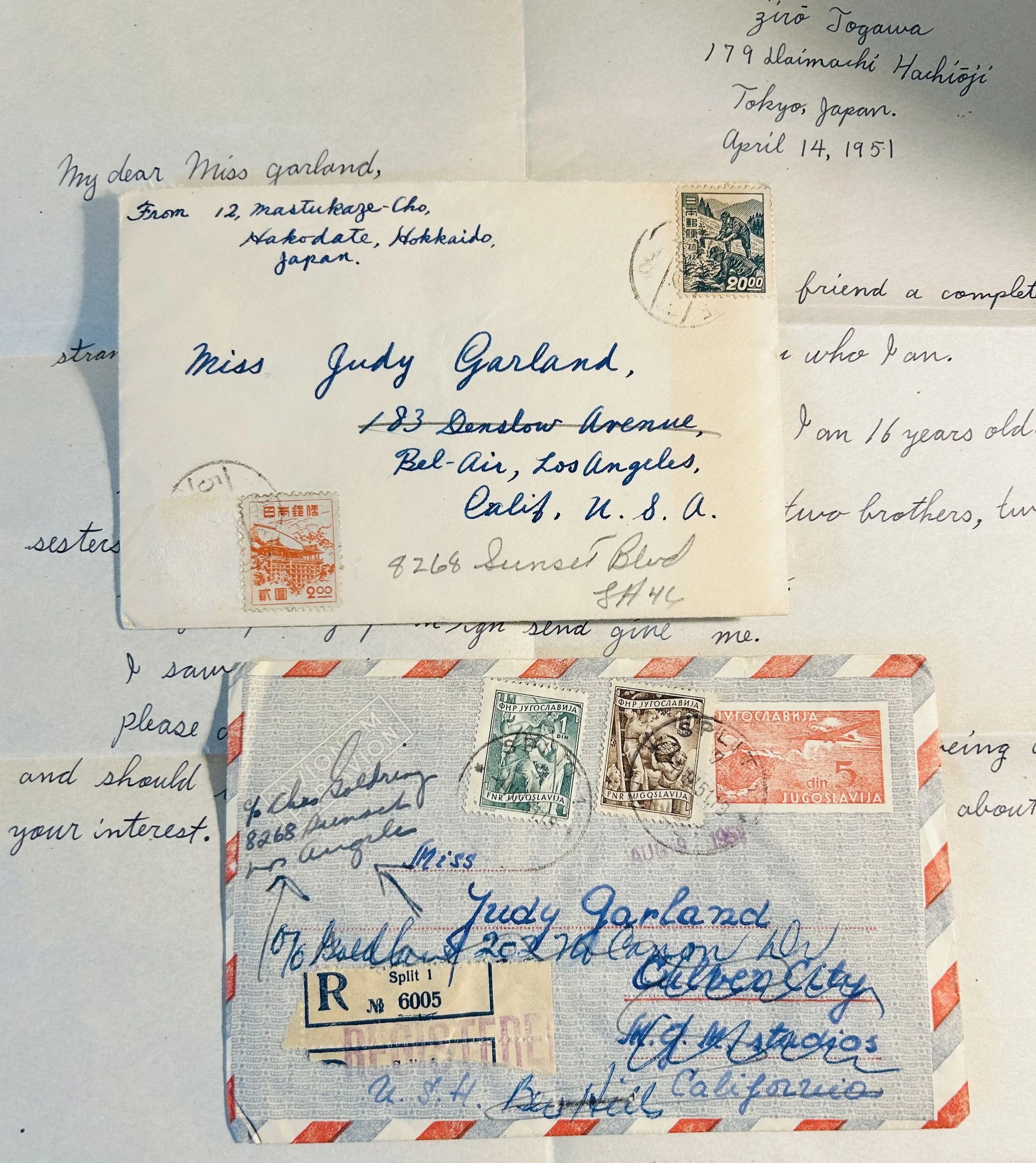
A few treasured letters written to Judy Garland — pieces of a legacy we are honored to preserve. “Archival correspondence from Judy Garland collection”
The voice of Judy Garland carries a rare and unmistakable quality—one that has endured across generations, not simply as performance, but as feeling.
It arrives gently, and then all at once—a warmth, a familiarity, a quiet invitation into something softer, more intimate. When she sings Have Yourself a Merry Little Christmas, the world seems to slow. The air shifts. And suddenly, you are somewhere else entirely.
A home, a table set with care, the glow of a fire, the quiet anticipation of something shared.
For me, Christmas has always carried that sense.
I think of my mother, moving through the kitchen with care, preparing the turkey and every detail that surrounded it. My sister, attentive, making certain everything was just right. My father, laughing as he played with our beloved border collie, Queenie—her name borrowed from a moment in Cat on a Hot Tin Roof, a small detail that somehow became part of our own story.
And in the background, always, there was music.
At the piano, I would find my way into her songs. Into that voice. Into that sense.
There were gatherings—grandparents arriving, the quiet excitement of opening presents, the simple pleasure of sitting together, of sharing a meal, of being present in a way that now feels increasingly rare.
It is that sense we return to.
That sense of simplicity. Of happiness. Of something unguarded and whole.
We hear it again when she sings Somewhere Over the Rainbow—a song that exists somewhere between longing and belief. It carries with it the possibility of a world just beyond reach, where dreams feel not only imaginable, but inevitable.
And perhaps that is part of what we miss.
Not simply the time itself, but what it allowed us to feel.
There was a certain ease to it. A rhythm. Days that seemed to unfold without urgency. Moments that were not documented, but lived. The kind of joy found in small things—a country fair, an evening at the movies, the quiet thrill of simply being somewhere together.
Films like Picnic, with William Holden and Kim Novak, carried that same atmosphere—sunlight, movement, possibility. They offered not just entertainment, but a way of seeing life.
And one wonders now—has that feeling disappeared?
Or has it simply been set aside?
Perhaps it was never as perfect as memory allows.
Perhaps it was always, in part, imagined.
But there is something meaningful in that imagining.
Because what those films—and what Judy Garland—offered was not simply nostalgia. It was permission to believe in something gentler. Something more generous. Something rooted in love, in kindness, in the quiet beauty of being together.
We still have access to that, in small ways.
In returning to the films.
In sitting down with a cup of coffee or tea and opening The Wizard of Oz by L. Frank Baum.
In revisiting the Andy Hardy films with Mickey Rooney and Judy Garland, where life, though imperfect, was always met with warmth.
And, perhaps most simply, in listening.
Because when Judy Garland sings, something shifts.
A softness returns.
A memory stirs.
A sense of possibility—however fleeting—reappears.
There is a reason her voice continues to resonate, long after the films have ended and the lights have dimmed. It lives not only in the music, but in the way it made people feel.
At Toast of the Season, we have had the privilege of reading, and preserving, personal letters. We are honored to own a collection of correspondence from Judy Garland herself, as well as letters written by those who admired her. They are filled with gratitude, with longing, with a kind of honesty that feels almost rare now. In those pages, you begin to understand the true reach of her voice—not simply as performance, but as connection.
People wrote of being comforted. Of being lifted. Of finding, in her voice, something that carried them through moments of uncertainty, loneliness, and hope.
And it is in reading those words that the magic becomes something more tangible.
Not imagined.
Not distant.
But deeply, undeniably real.
And perhaps that is what we are truly seeking—not a return to the past, but a way of carrying its best qualities forward.
A little more kindness.
A little more presence.
A little more care in the way we gather, the way we listen, the way we live.
Because in the end, it is not the moment itself that remains.
It is the feeling.
And that, beautifully, is something we can choose to keep.